

JOIN and UNION are staples in SQL. In English they’re synonyms to each other, but in SQL they behave very differently. They work in different directions.
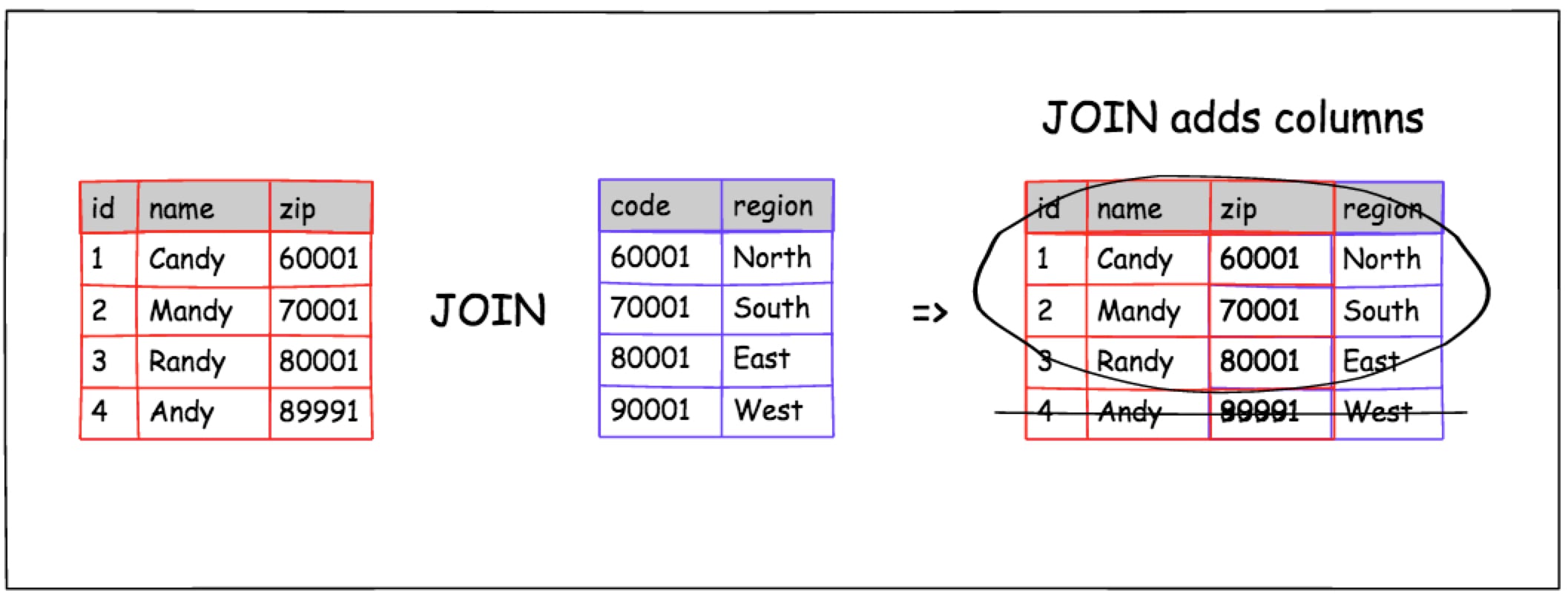
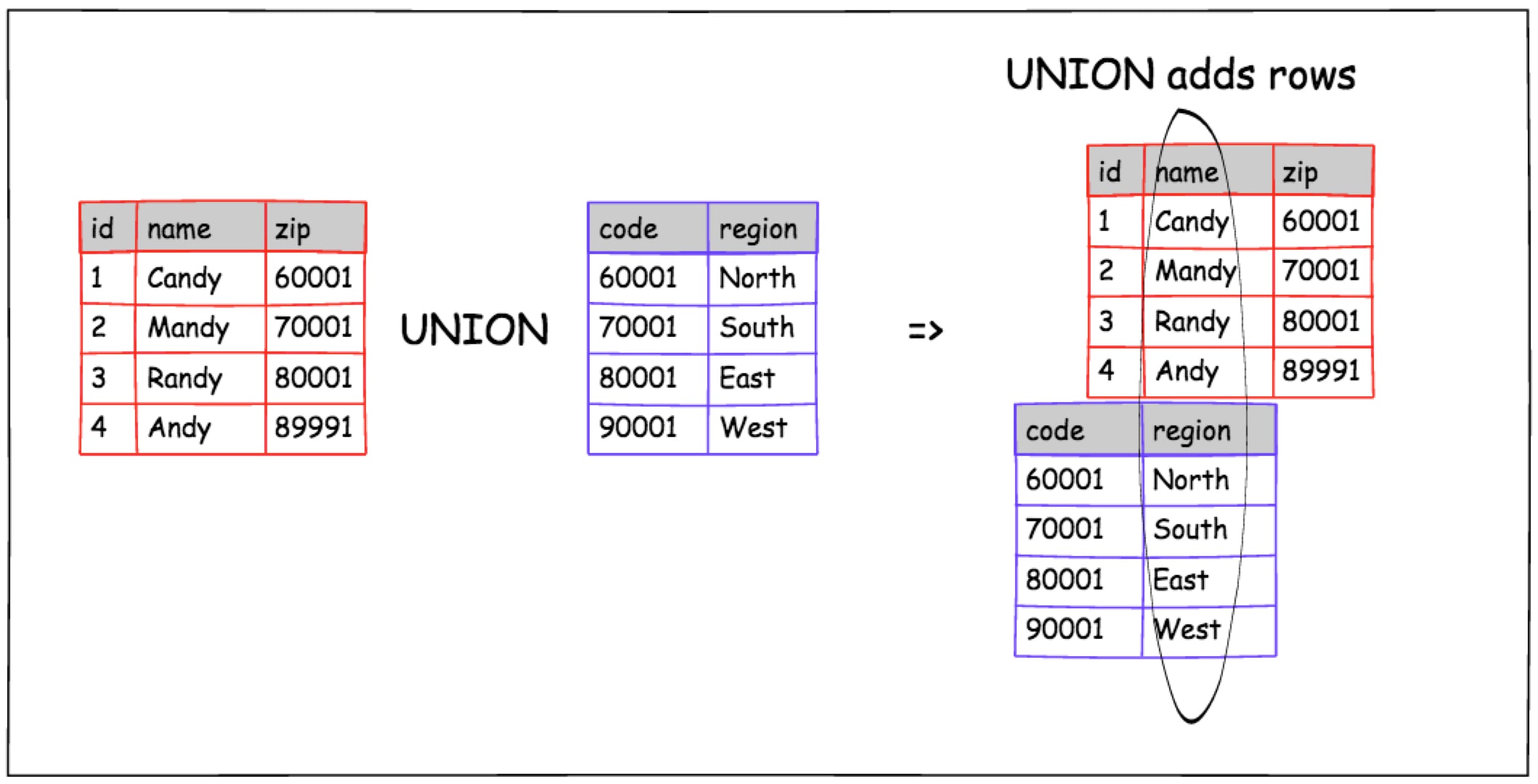
TL;DR - Use JOIN to add columns. Use UNION to add rows.
According to Wikipedia a JOIN is:
An SQL join clause combines columns from one or more tables in a relational database. It creates a set that can be saved as a table or used as it is. A JOIN is a means for combining columns from one (self-join) or more tables by using values common to each. ANSI-standard SQL specifies five types of JOIN: INNER, LEFT OUTER, RIGHT OUTER, FULL OUTER and CROSS. As a special case, a table (base table, view, or joined table) can JOIN to itself in a self-join.
And here’s their definition for UNION:
In SQL the UNION clause combines the results of two SQL queries into a single table of all matching rows. The two queries must result in the same number of columns and compatible data types in order to unite
— https://en.wikipedia.org/wiki/Set_operations_(SQL)#UNION_operator
!!! tip “Memory Tip”
UNION adds rows UNder the results.
`JOIN` has not tip, but it's not a `UNION`.Data Setup
We’re going to use a 2 table database. People belong to a zip code and zip codes have a named region.
!!! success “Schema” ```sql CREATE TABLE people AS SELECT * FROM ( VALUES (1, ‘Candy’, ‘60001’), (2, ‘Mandy’, ‘70001’), (3, ‘Randy’, ‘80001’), (4, ‘Andy’, ‘89991’) ) AS t (id, name, zip_code);
CREATE TABLE zip_codes AS
SELECT * FROM (
VALUES
  ('60001', 'North'),
  ('70001', 'South'),
  ('80001', 'East'),
  ('90001', 'West')
) AS t (code, region);
```
JOIN Problems
The best time to use a JOIN is when we need to show a column from another table which correlates to a column from a previously declared table.
Problem:
The Sales Team would like a list of people’s names with their regions.
Create a query with each person correlated to the zip code region?
!!! success “Solution”
sql SELECT people.id, people.name, people.zip_code, zip_codes.region FROM people JOIN zip_codes ON zip_codes.code = people.zip_code;
| id | name  | zip_code | region
|----|-------|----------|--------
|  1 | Candy | 60001    | North
|  2 | Mandy | 70001    | South
| 3 | Randy | 80001 | EastProblem:
List all the people who belong to an unknown zip code?
!!! success “Solution”
sql SELECT people.id, people.name, people.zip_code, zip_codes.region FROM people LEFT JOIN zip_codes ON zip_codes.code = people.zip_code WHERE zip_codes.code IS NULL;
id | name | zip_code | region
-- | ---- | -------- | ------
 4 | Andy | 89991    |
JOIN Notes
INNER JOINandJOINare interpreted identically. The later saves typing 6 characters.INNER JOINis great for finding correlation, but bad for finding unmatched records.LEFT JOINtells the query engine we want to return all data on theLEFTor earlier tables even though the correlated value doesn’t exist.RIGHT JOINis the opposite ofLEFT. They retain rows from tables mentioned later in the query.- Mixing
LEFT JOINwithRIGHT JOINin the same query should be avoided. - The
WHEREcondition states we only want the uncorrelated rows, thepeoplemissing azip_codesrecord.
UNION Problems
The UNION clause allows us to conform 2 or more unrelated results into a single uniform results.
Problem
The search department wants a list of all keywords for their search index.
Return a list of keywords from both the people and the zip code tables.
!!! success “Solution”
sql SELECT name AS keyword FROM people UNION SELECT region FROM zip_codes;
| keyword |
| --------- |
| East |
| North |
| South |
| Mandy |
| Candy |
| Randy |
| Andy |
| West |
Problem
The search department likes the results, but wants to be able to correlate the row back to its source table and row.
!!! success “Solution”
sql SELECT 'people' AS source, id::varchar AS key, name AS keyword FROM people UNION SELECT 'zip_codes', code, region FROM zip_codes ORDER BY 1, 2, 3;
  source   |  key  | keyword
-----------|-------|---------
 people    | 1     | Candy
 people    | 2     | Mandy
 people    | 3     | Randy
 people    | 4     | Andy
 zip_codes | 60001 | North
 zip_codes | 70001 | South
 zip_codes | 80001 | East
 zip_codes | 90001 | West
UNION Notes
- The
UNIONclause requires all the columns from its sub queries to be the same number and type. This is why::varcharcasting was added. UNIONdefaults to only returning distinct rows between the result sets. If you want all rows regardless of duplicates tryUNION ALL.ORDER BYwithUNIONworks on the final results. When ordering is needed within a sub query use parenthesis. Ex:UNION (SELECT ... ORDER BY ... LIMIT 1)
Bonus Problem
Return the people with invalid zip codes without using JOIN.
Hints:
EXCEPTis the inverse of aUNION.EXCEPTremoves the results from the source query instead of appending them.INcan be used as a matching clause in aWHEREfilter.
!!! success “Solution”
sql SELECT people.* FROM people WHERE zip_code IN ( SELECT zip_code FROM people EXCEPT SELECT code FROM zip_codes );
 id | name | zip_code
----|------|----------
  4 | Andy | 89991
Closing
!!! success “Clean Up”
sql DROP TABLE people; DROP TABLE zip_codes;
JOIN and UNION are an essential part of a SQL users tool belt. On a day to day basis, JOIN is used more often than UNION, so we would recommend understanding it first. UNION gets it power when we realize our data is more alike than originally intended. Both clauses should be withheld at dinner parties and other social events.
Happy SQL-ing!